
Deep-Tech for Accelerating Lead Optimisation
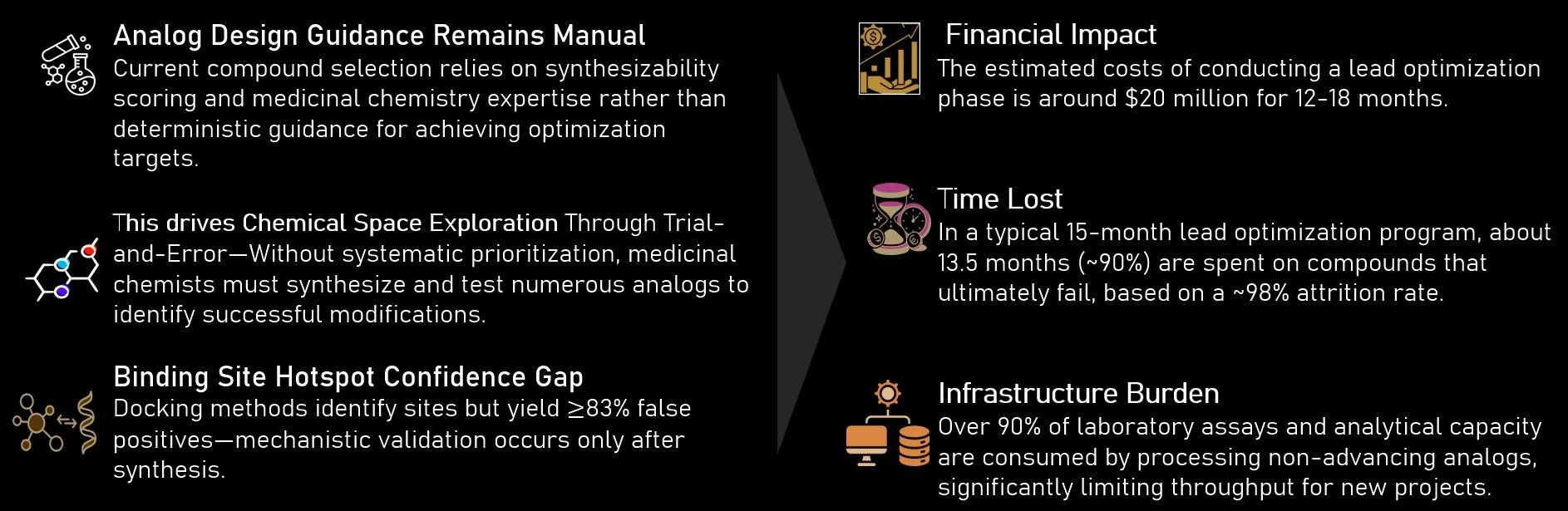
Lead optimization represents the final opportunity to refine compounds before costly preclinical programs. Current approaches assess structure-activity-property relationships but lack guidance on which analogs to prioritize for multi-parameter optimization success.
Molecular Complexity and Biological Function
In order to accelerate drug optimization and minimize costly, labor-intensive analog synthesis, the industry needs deterministically relevant tools that are across chemical space and scalable for everyday R&D.
Quantitative Complexity Theory (QCT), which powers Artificial Intuition, bridges physics and information theory providing the first dynamic molecular complexity metric, which quantifies the amount of information encoded in a particular structure, linking it with biological function.
QCT: bridging Dynamics, Structure and Information
Analyzing the dynamics of atomic interactions in a generic molecule, QCT pinpoints “complexity hotspots”/potential pharmacophores, which drive its biological function. This allows to streamline lead optimization reducing the number of synthesized analogs.
Methodology: Molecular Dynamics + QCT complexity analysis identifies atomic participation factors measuring hotspots each atom's contribution to molecular dynamics.
Optimization Guidance: Distinguishes atoms essential for activity from those suitable for modification to improve ADMET properties without compromising potency.